
Shane Hughes 2-15-26
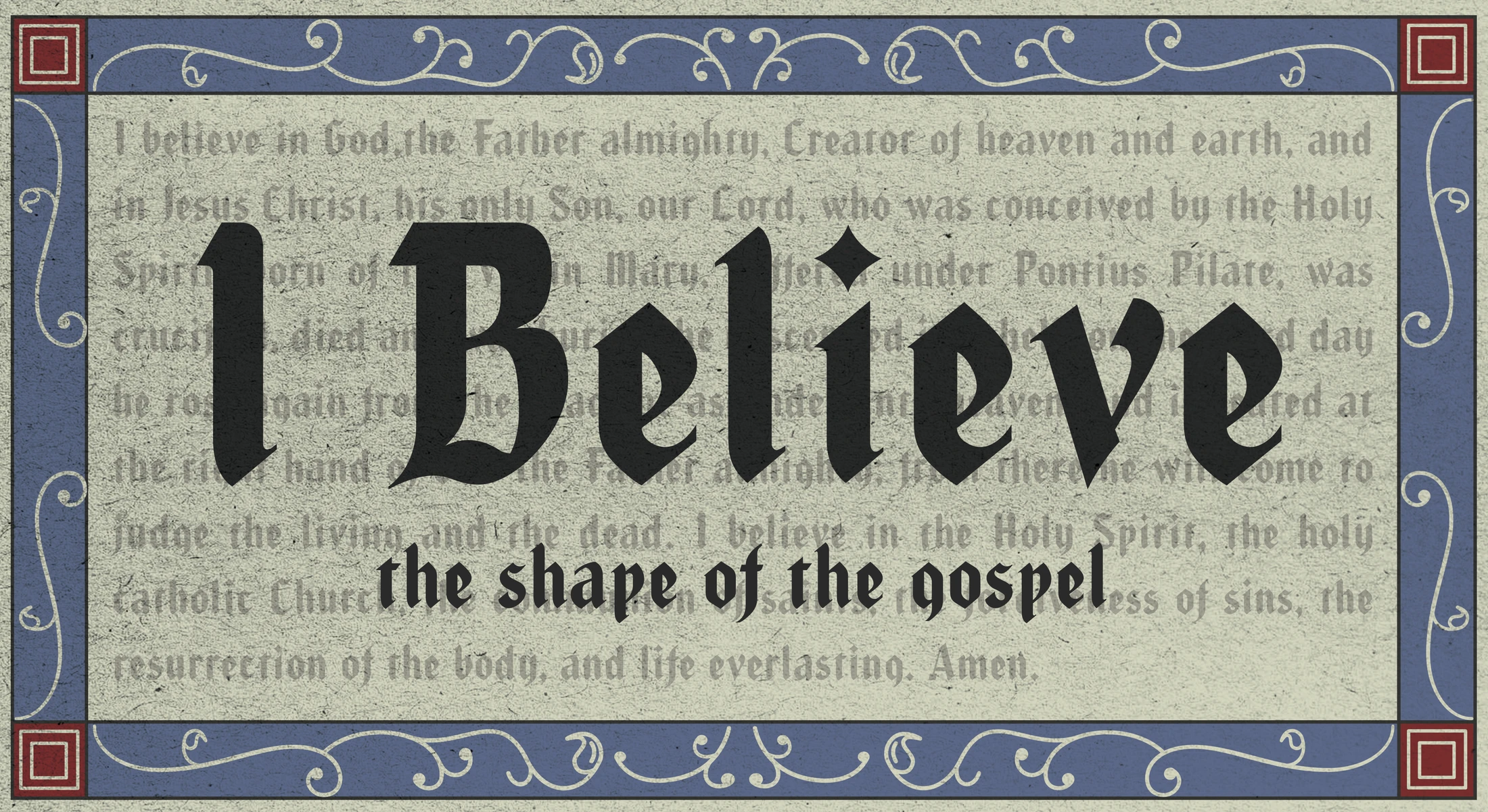
My name is Shane Hughes. I'm one of the ministers here. It's a delight to have you with us. As you heard from Steve and from Jeff, we're starting a new series this week that's going to carry us through Lent. And I am.
I'm excited about what we're going to experience together about last spring. I think I might have told you this story before this spring. My good friend David Romanick, who is the rector over at Heavenly Rest, invited me over for a Wednesday night. They were celebrating because the Nicene Creed this year turned 1750 years old. And so they were spending some time looking at the decreed from different perspectives.
And so David and I were having lunch. He said, hey, I'd love to come over and talk about this. I said, that's great. What do you want me to talk about? Because if you want history or you want theology, I got a lot of people at Highland that can really help you.
And he said, no, no, no, no, no, don't worry about that. I want you to take a. Take us through what an anti creedal church thinks about the creed.
And I said, I can do this, but I don't know if you're going to like it. And he said, oh, well, you know. And I said, really, you need to have somebody like Brad east come. Let Brad east. He's going to do amazing.
He's like, oh, he's coming the week after you. Which gave me a lot of peace because no matter what I did, Brad could clean it up. That was good. But there was an early slogan in the churches of Christ in the restoration movement that said, no creed but Christ, no book but the Bible. We are by definition kind of an anti creedal movement.
We don't feel like we need these extra things because we have the Bible. And this is kind of the example that they talked about. If you held up the Bible in one hand and the Book of Common Prayer in the other hand, you would have an Anglican or an Episcopalian, right? Or if you held up the Bible in one hand and the Westminster Confession in the other hand, you would have a Presbyterian. If you held up the Bible and the Book of Mormon in one hand, in the other you would have the Church of Latter Day Saints.
But what happens if you just hold up the Bible? Well, we would make the argument you have a Christian or you get the Church of Christ. Now, there's something that's very noble about this sentiment. There's also something that has a little hint or a tinge of arrogance in it. But there's Something very noble about this idea that we don't need anything extra.
This, The Bible is enough for us. It's all we need to do to explain it. And so I was at that Wednesday night, and I was. I was talking to this room full of Episcopalians, and I was beginning to explain one piece after another, why you don't really need the Nicene Creed, that Scripture is enough. And then I began to poke holes at the Nicene Creed to say, you know, there was some politics involved in this.
And every time you create a creed, that means somebody wins and somebody else loses, because what used to be kind of the edge of orthodoxy becomes heresy. And in the past, Christians haven't been very good at treating heretics very well. We tend to persecute them and treat them poorly. And so I said, in some ways, creeds are divisive. In other ways, creeds are political.
But if you just have the Bible, then you have enough. And I noticed in the room as I'm making this argument that eyes begin to narrow and dark clouds begin to form, and I'm stepping on. I realize I'm trotting on holy ground a sacred peace. And so at the end of the talk, I try to wrap it up and say, yeah, but the Creed also has lots of value, and here it is. And I talked to David afterwards, and I said, hey, I noticed toward the end of this talk that people didn't seem to appreciate it.
And he said, yeah, you don't know what the Creed actually does. I said, yes, I do. I understand historically and I understand theologically. I understand philosophically. I understand all those things.
He says, no, we say it together every week. You don't know how the Creed forms us. And I thought to myself, yeah, I don't. But we do say the Lord's Prayer every week, and we do see how it forms us. And I love what Ashley said, that in our church, we have evolved this own little rhythm by which we say it.
You know, this. This. This syncopation when it comes to. Because we are doing something unique that's happening just here. But I'm curious now.
I'm curious what happens when we say A Confession together? And so during this series, for the next few weeks, at the end of the sermon, at the benediction, I'm going to invite you to stand, and I'm gonna invite you to say the Apostles Creed. It's a statement about what we believe together. And if you're not there yet because you're not quite Christian or you're not sure that you Want to get messed up, involved in all this. You don't have to say it, just stand there and listen to it being said over you.
But I wonder what happens when we begin to be formed by these words. And I want to offer one little thing in the middle of it. If you've never seen the Apostles Creed before, there is in the middle of it, I believe in the Catholic Church. I want you to notice that Catholic, that C is a small C, not a capital C. So there. We're not referring to the Roman Catholic Church kind of that organization.
What we're talking about is the little C, the universal church, the Church that has existed in all times, in all places and everywhere. That's what we're talking about when we say that word Catholic. But I want to think about why we would talk about that. Why would an anti creedal movement spend some time thinking about the Apostles Creed? Well, I do think it does add a couple of benefits.
The first is clarity. And the second is confession. And I mean clarity in two different ways. I took a trip to my mother in law's house a few months ago and she has this mirror that flips. And one side of the mirror is like a normal mirror, but if you flip it on the back, that side of the mirror, it's like concave and it's a magnifying mirror.
And I began to examine my face in this magnifying mirror and I saw all sorts of things that I didn't know was there. It took me down half a notch. Maybe my face is a lot more complicated than I normally imagine it to be. The mirror gave me clarity and I think the Creed kind of functions that way. It's a mirror that allows you to see your own kind of theological location.
It allows you to reflect on what you believe. The second way I think it provides clarity is in the way that the bass and the percussion, the rhythm section, provide clarity. In music, especially jazz or people that very skilled musicians, you can be lost in what key they're in. You can be lost on where their beat is. You can be lost because the syncopation is taking you to places you never imagined.
But as long as you can hear the bass, you know where the tonic beat is, you know it's going to resolve eventually back to the tonic back to do you know, it doesn't matter how complicated the beat is, eventually you're going to get back to that 4, 4 beat that you can hear in the bass. It provides clarity. Now the origin story of the Apostles Creed, the one I love, is that the 12 apostles sat down together and each of them contributed a line. And you can kind of see 12 different sections there. And that.
That may be true, but. But I think what's more likely is the reality is that this was a baptismal confession in the early church. One of the most ancient things in church history was, was that this was a way that new believers could say they would believe. And so they might be asked questions, they might come to the. To the Baptistry or to a river to be baptized.
And they would ask them, do you believe in God the Father? Do you believe in Christ the Son? Do you believe in the Holy Spirit? Do you believe? And they would answer, I believe.
And so I love the Apostles Creed because it's not created by a council. It's not part of any sort of deliberate theological strategy. It was a grassroots confession of faith. It was this indigenous form of. Of the ancient church's response to the risen Christ.
And so we're going to spend some time. One way to think about it is we're just going to hang out in the baptism part of our pathway for the next few weeks. Because what the Apostles Creed is, is it's kind of a summary of Scripture. It gives you this condensed model of exactly what's in there. And with baptism, as we saw today, you need two things in order for it to work.
You need confession, and you need the water. If you have the water without the confession, then you're just taking a bath. There's nothing powerful in that moment. And you can have the confession without the water, but it's not lasting. There's not that formational moment of where you meet Christ in the water, where you mimic his death and his resurrection.
You have to have both. The Christian faith is mysterious not because it's so complicated, but because it's so simple. A person doesn't start with baptism and advance to higher and higher mysteries. It's not like there's different levels that you haven't seen yet. In baptism, each believer already possesses the faith in its fullness.
Irenaeus, who is a theologian in the early church, said, since the faith is one and the same, the one who says much about it does not add to it, and the one who says little about it does not. Does not diminish it. In your baptism, in your confession of faith, you already have everything you need. And so the Creed was a tool to clarify, inform Christians around what is true. Because you can't just say whatever you want about God.
I mean, you can, but. But. But sometimes you. You're Outright wrong. And being wrong can cause harm to others and to yourself.
And so I want to push back gently against this notion that all you need is like, a little personal devotional time and God. You need so much more than that. You need the community of faith around you to kind of correct and help clarify and help help you understand your own confession as you grow into it. What is. What is true of God is so important that thousands of Christians, perhaps even millions of Christians, have died for it.
And so this is why the Creed is useful. It gives us clarity. It allows you to summarize Scripture and talk about the most central aspects of your faith. I don't know if this has ever happened to you, but you could imagine if it never has, that you have a friend who's not a believer and you love them deeply and you spend a lot of time together. And.
And so one moment over coffee or lunch, they just kind of ask you, and it's the question that you've been longing for them to ask you since the very beginning. Hey, what's up with Christianity? Why do you believe in God? What's the deal with this? What's so important about this?
And, you know, you have about two minutes to give them an answer that makes sense. What do you say? Well, you've got to talk about God, you've got to talk about Jesus, and you want to talk about the whole Holy Spirit, and you want to talk about salvation, and you want to talk. Do you see the. See the situation?
How can you say all those things concisely? Well, it's right here. It's right here. And Scripture is trying to do this, too. And the text that we heard this morning from First Corinthians, that's what Paul is doing.
Did you notice what he said? He said, look, that Jesus was alive in accordance to Scripture and he died in accordance to Scripture. He was raised again in accordance of Scripture. And. And what he says in one or two sentences is actually a pretty phenomenal summation of the Old Testament's relationship to Jesus Christ.
He does it so quickly and so succinctly and in an elegant way, you don't even realize what he's doing. This also happens in the Pastoral epistles you come across. And it'll say, hey, here's a saying that deserves good acceptance. And then he gives you kind of this quote, and it's a summation of everything. So Scripture is doing this, and the creed is doing this.
The other thing that the creed does is it kind of protects the mystery of God from Dissection. Every time there is a person or a group that tries to pull God apart, you can imagine he tries to do an autopsy where, like an ant, where they open it up or if you ever dissected a frog before, and they look inside and you want to see all the parts and how they work, and they push theology to the edge.
The creed pulls us back. No, God wasn't. Jesus wasn't fully human and not God. Of course not. He was fully human and God.
No, no, no, no. You don't understand. He wasn't. He had to be human. He must be human and he must be fully God.
The creeds protect the mystery of God. At their best, creeds articulate in whom and in what we trust and to whom and to what we are loyal. They also confess our limits of our comprehension and recognition, the limits of the knowledge of ourselves and others, our communities, the words and God.
And so what we're going to do is we're going to begin this Sunday thinking about the Scripture that scaffolds the Apostles Creed and the Creed. The one thing you'll notice the refrain that happens over and over and over is the words, I believe. And so I want you to think for a moment about the voices in Scripture that speak about faith. There are some pretty obvious ones that speak directly about faith and then some stories that show what faith looks like. And it's in the Old Testament and the New Testament.
In the Book of Hebrews, the author says that faith is confidence of what we hope for and the evidence of things not seen. James wants to add to that by saying that faith is not just intellectual assent. He pauses to say, even the demons believe in God, but rather, faith is action. It's your doing that shows, demonstrates your faith. Job, who had been rung through the wringer, he says, and his statement of faith is, I know that my Redeemer lives.
My favorite, though, is in Habakkuk. Habakkuk has seen kind of the desolation of what's happened to his people. And he says, though there are no cattle in the stalls yet I will rejoice in God, my Savior, even though I can't see it with my own eyes, the benefit of God. I'm going to rejoice in the presence of God. And Jesus talks about this everywhere.
But in particular, we're going to look at Mark, chapter nine. There's this story where the disciples have tried to exorcise a demon out of a child, but they can't do it. And Jesus in that moment is a Little bit frustrated with them. He says, you faithless generation. Then he says, bring the boy to me.
And he has this conversation with the boy's father. And Jesus says to the Father, this is verse 23, if you are able, all things can be done for the one who believes. And immediately the father of the cry, father of the child cried out, I believe, help my unbelief. So in the course of that conversation, Jesus says, do you think I can help your son? And the Father responds, are you able?
If you're able, if you are able, all things can be done for the one who believes. Immediately the Father of the child cried out, I believe, help my unbelief.
What is possible if you believe in God.
I think what Jesus is saying is I can do all things. I don't think Jesus can be manipulated. I don't think this is magic where if you say the right words, the right incantation, you're going to get God on your side and God will do things for you. God will make your life better and you'll make more money. I don't think this is what that is.
I think that what this is, is that what Jesus is saying is, I can do these things and I will do this miracle now, but I'm gonna do it through the medium of your faith. And this is consistent throughout scripture. God seems throughout scripture to choose to partner with the willing, even if they're scared or even if they're worried or they're not 100% confident that God is going to show up. This is how God chooses to work and in the world. And I think when Jesus says, if you're willing, I will do this thing, immediately that man becomes extraordinarily self aware of his own belief and doubt at that moment.
Because more than anything, what he wants is for his son to be healed. But he knows and he's honest with himself to say, hey, I believe in one hand, I also don't believe in the other hand. Could you help me with this side? Because I really want this to happen.
I think a lot of us live there. I believe help my unbelief.
And I'm not going to fault anybody for holding unbelief in their own heart. The opposite of faith isn't disbelief. The opposite of faith is certainty. Especially when you look at the world and you see all the everything that's wrong with it. Especially when you don't hear from God.
You pray and you pray and you pray and you pray and your prayers seem to go no further than your breath. I mean, God has done incredible things in the past, but will God do them again? Can we even trust God? Is God trustworthy? Yeah.
Help my disbelief, help my lack of faith. So it makes sense when Israel, sitting at the base of Mount Sinai, after walking across the reed sea with dry sandals, the suddenly thinks to themselves, you know what we should do? While Moses is up on the mountain getting the law. We should build an idol. It makes total sense.
They just saw the 10 plagues. They just saw the God of Israel defeat every God of Egypt. They just saw the miraculous walk through the. Through the reed sea. They saw God deliver them from the power, the greatest power that existed at the time, Egypt.
It makes total sense that they wonder, you know, God was faithful there, but can God help us through the desert? Maybe we need a different God to get us through the next step. I believe help my unbelief. And the interesting thing that we see in Scripture is that God does not seem that anxious about living on the edge between belief and unbelief. Jesus is not anxious in this story, talking to this father about whether his father, whether this father is willing to be the medium of faith for this power to be expressed.
He is frustrated with his disciples, but he's not frustrated with the guy that's wrestling with whether this can make it work. Look, faith and knowledge are not the same thing. People know all sorts of things, and it doesn't change anything. Nearly every person I've ever met that smokes knows that smoking is bad for them. Like for whatever happens in America in the last 40 years.
What we have done very effectively is communicate that smoking will eventually harm your health enough to kill you. I've never met a smoker that doesn't know that.
But that knowledge doesn't translate to quitting. That knowledge never gets to the point where it changes their behavior. And before I throw very many rocks, I eat a lot of fries. So I'm not gonna blame anyone for this. No judgment here, right?
I know that these aren't good for me. They just taste so good.
But Paul in Romans says that belief, it doesn't come from your mind. Belief comes from the heart. And it moves from the heart to the lips. And I think most fundamentally, what it does is it shifts faith toward a posture of believing the right things to a posture of embodying the right things. Another way to say that is orthopraxy.
The right things we do is way more important than our orthodoxy. The right things we believe, although they both matter, right? You have to be able to do the right Things and knowledge is not going to save you. I was in college one year, and it was right around Valentine's Day, and I was dating this girl, and she said to me, hey, I want to plan Valentine's Day this year. And I said, that sounds great.
Let's do it. Whatever you want to do sounds great. And she said, okay, I'm going to plan it this year. And then she came back a little bit later. She said, hey, what I think we were going to do is I want to have a double date with my roommate and my roommate's boyfriend so we can all go together.
I said, that's great. So she said, it's going to be a surprise. Just show up at this time, this place, and be ready to go. And I said, that sounds wonderful. And so I show up to a certain time and a place, and I see this other guy, her roommate's boyfriend.
He's walking up, and in one hand, he's carrying this plastic or, excuse me, a paper bag full of flowers that he made by hand. And on these flowers that he made by hand, some of y' all need to be taking notes. He wrote on the lips of the flowers the things that he loves about his girlfriend, the things he admires about her. He adores her. And on the other hand, he has a box of chocolates.
And as I'm walking up to see him, I look down at my hands and I have nothing. Because I wasn't planning this date. I had that knowledge. I knew I wasn't in charge, and so I didn't think to do anything that showed appreciation or adoration. I don't think I lasted more than, like, a week and a half after that date.
But it's like. I think it's a country song like God Bless the Broken Road that taught me all the stupid lessons so that I don't do them to the person that I end up committing to. Right? Like, there's something there about that. Right?
That belief is love in action.
It's not just the knowledge that sits in your heart. Maybe belief or faith is more akin to trust.
Can you trust God to keep the promises that God has made? And it's hard because we've all lived in a world where someone has broken a promise. We're kind of in that season of politics revving up in our area. And I don't know about you, but in my house, I've gotten probably nine or ten different political ads for different candidates that are excited about running for different offices. And it seems like they.
They just keep Trying to one up one another like who can be the most political, you know, and they make different promises and, and we understand that those promises are motivated by self interest and the words are a tactics to achieve other aims. Do we expect politicians to keep them? Well, I think that's a cycle of disappointment. Got me again.
And that can make us cynical, not just about other people's promises. It can make us lack confidence in our own words too. There is a certain irony of someone that makes solemn promises of lifelong commitment and a wedding ceremony after signing the prenuptial agreement. Without trust, Augustine says we would be unable to do anything in this life. Without trust, we would be unable to do anything in this life.
You would not have sat down in the chair that you're sitting in right now if you didn't believe that that chair could hold you. And you would not move out of your bed in the morning if you did not have some sort of fundamental agreement of trust of the physics in this world that when you put your foot on the floor, your foot will hold, the floor will hold you and your foot just won't fall straight through. Breathing is an act of trust.
And that trust changes behavior.
And look, and here's the piece of this that I need you to wrestle with. If this is true, if this is true, it is true for everyone. And there is a universal claim here. And the reality is I might be wrong on the things that I'm claiming are true. I'm going to spend my entire life telling all of you and anyone else that will listen to me about the wondrous goodness of God.
And then at one point in my life, I am going to find out in the end if I wasted my time or not. But if it is true that it's not just true for me or true for us here at Highland, it's true for the world. It's true for everyone, everything, everywhere.
And so our faith requires confession. We need to say it and we need to say it out loud. And the reality is, in the Christian faith and the history of the Church, confession may cost you something. Confession may cost you everything.
Augustine writes that we can absolutely trust God. If God is not trustworthy, then this whole thing falls apart.
But how do you know? And here's the mystery. And he said this 1700 years ago, and it's still so powerfully true. He said, you don't start by verifying. We begin by trusting.
He writes, if you can't understand, believe, and then you'll understand.
Your faith doesn't begin with an intellectual Assent. Your faith begins with a step of trusting God is who God said he is. And this is Ben Myers. I love this quote. That doesn't mean that Christian belief is an irrational leap into the dark.
It's more like tasting a dish you have never tried. You've seen other people enjoy it, you've read the reviews. The chef swears that you'll like it. And there are good grounds for trusting, but you will never know for sure until you try it. Or, as the psalmist says, taste and see that the Lord is good.
And so there's this, this voice in scripture that says that God, who can do everything, Christ, who can do all things, the way that they kind of choose to partner is with human beings, that you might be the conduit, you might be the vehicle for God's power in this world. And I want to leave us with the question, what is possible when we believe, what is possible? What can God do? And the reality is we don't know until we try.
Taste and see that the Lord is good. Would you please stand with me for our benediction? Like I said, let's. Let's say the Apostles Creed together. We're going to say it every week.
If, if you're not sure you can assent to it yet. Just wait, just wait. Just hang with us and see what happens. And let's see how we're formed. Let's see how we're shaped when we say this together.
I believe in God, the Father Almighty, creator of heaven and earth. I believe in Jesus Christ, his only Son, our Lord. He was conceived by the power of the Holy Spirit and born of the Virgin Mary. He suffered under Pontius Pilate, was crucified, died and was buried. He descended to the dead.
On the third day, he rose again and ascended into heaven and is seated at the right hand of the Father. He will come again to judge the living and the dead. I believe in the Holy Spirit, the Holy Catholic Church, the communion of saints, the forgiveness of sins, the resurrection of the body, and the life everlasting. Amen. Go in peace.