
Shane Hughes 2-22-26
Oh, and thank you for that wonderful reading. That was beautiful. In first service, we had Kyle do the reading, and I grabbed Kyle right as he was walking off, and I said, hey, come back on stage, because Kyle's an elder and he knows stuff. And. And I complimented Kyle because Kyle has this deep resonance in his voice that makes lesser men envious.
And I just love to hear Kyle read scripture, But I just wanted to ask him a couple of questions. Now, Kyle was completely unprepared. I literally asked him if I could do it while we were sitting over there during the bumper. And he was a good sport, and he said, sure, but now you know what the questions are. Is he gonna throw me a loop?
Yes. Different questions. Completely different questions. No, no, no, no. Same thing.
I want us to think about theology and how we do theology. Not necessarily how experts do theology, but just practical people, how we think about theology. So take, for instance. I want you to help me with one thing. There's a story in Genesis about Joseph.
You familiar with that story? Yes. Okay. And he is kind of arrogant. He's the favorite.
Jacob loves him the best. His brothers don't love that very much. And so they throw him in a pit. That's right. To kill him.
And then one of his brothers is like, ah, we can make more money if we sell. Sell it. Right, right. I'm doing so far so good. You're doing okay.
So. And then the rest of his life kind of goes like this. He's sold into slavery. He ends up at Potter's house. That goes well, until it doesn't.
And then he ends up in a prison. And in that moment, there's these. He has contact with two people that know Pharaoh, who's like the emperor, the highest person, the biggest power in the world. And. And Joseph interprets their dreams.
So he's going to get out of prison, except immediately they forget. And he stays in prison for three more years. But then one of them is like, oh, yeah, there was this dude that could do dreams. And so Joseph gets out, and he becomes second in command, vice president of Egypt, and he saves the world because there's a famine coming. He knows what's coming.
He's ready for it. He has the skill to kind of make sure that Egypt has enough grain. He saves the world. And then there's that moment where his own family, his brothers that sold him into slavery, come looking for food, and he's able to make peace. All right, so what's the message about Joseph?
At the very beginning, Joseph in the. In the pit what's that? What do we make of that? So one thing is he's just stuck. Right.
Right. Waiting. Although I went back and looked. It's not real long, but it is wild. Wow.
And so I've never spent a lot of time in a pit, but I imagine any time in a pit is wild. A lot more. A lot more time in the pit than. Than I spent this week. Yes.
Yeah. But yes. So probably trying to figure out what was next and trying to figure out what God had in store for him, but there's not a whole lot there in scripture. Right there at that point. Maybe that's where you're going.
Maybe not. Maybe, Maybe not. Let's see where you take it. What. What do.
What would we say? How does this story apply to us? What's the meaning of the story that we walk away with occasionally? I think. I don't know about you, but I find myself in the pit.
Yeah. Not that literal pit necessarily, but. But a hard time. A hard time. And there are lots of.
I went. I was looking. There are lots of pits mentioned in scripture all throughout the psalms. I was talking about Jeremiah and the cistern as well. But God's there for us in the pit.
But we. We there. It takes a lot of scripture for us to. To see the whole picture sometimes. Right, Right.
Because if I were to take, like, a literalist reading of that text, one thing I might say is, look, if you're. If your brothers sell you into slavery and you find yourself in the pit, you know, just be. Be smart and. And do well afterwards because then it's going to go better for you. Like, I think that's the literal meaning of that text.
Right. But you come out with a different meaning, which is like kind of God is with you. Right. That we're trusting, we're hoping, we're waiting for the next thing that God's going to do. Yeah.
Wait for God to act. Because sometimes a posture of waiting is the right posture to hold. But what if there was a different interpretation of this text that said, actually, you know, God is. God is pretty capricious, and either he doesn't care about you when you're in the pit, or you're not worth bothering because you're just kind of insignificant little dude and why would God deal with you anyway? Maybe you deserved it.
Why don't we walk away with that meaning of the text? Well, in the moment, we might. Right. When we're in it. Yeah.
That is the. That's kind of what you were talking about Wednesday night, the Little creature on our shoulder saying as much. Why do you think you're going to get treated any special way? What's so special about you? But we know that God is faithful.
We. We have to wait. And sometimes it's a really long wait. How do we know God is faithful? We've seen it many times.
Okay, he comes through and now. This is difficult. This really is ad lib, folks.
We've reached the end of the script. We're at the edge of the mystery that Tim was talking about. Yeah. I mean, because you've seen it, right? You've seen it in your own life.
Right. And we've seen it in scripture. Correct. Jesus is faithful. Even in Jesus's deep pit, God shows up in the life of the church.
God is faithful in those hard moments. God shows up through the Holy Spirit in the Old Testament. So in some ways, I guess what we could say then is the way that we interpret a text, the way that we do theology, is in the context of scripture and in the context of our own experience. True, true, true. Do we agree?
Yes. No. All right, let's give Kyle a hand. Thank you, Kyle. Thanks.
All right, so I want to think about that. What is the point of the story of Joseph and the well? And if you're. If your understanding of God is malformed or twisted or inadequate, then you might come across with the wrong interpretation of what that time in the scripture is for, what it's there for. Sometimes when we're in the hardest parts of our lives, God provides ingenuity and wisdom so that God can use hardship for good.
And you might make that argument about Joseph because even though God shows up to Jacob and wrestles in the form of an angel, and God shows up to Abraham telling him what to do and correcting him, God shows up Isaac in the form of the fear. In the story of Joseph, God doesn't really show up and intervene in some sort of miraculous way. In fact, you could argue the only way that God shows up in the story of Joseph is just by making Joseph smart and capable. He gives Joseph gifts that Joseph carries out. But we read this text.
We read this text through the lens of Scripture itself. And in fact, we read scripture through the lens of scripture. Now, how are you sure you get that right? Well, you got to spend a lot of time in scripture. You got to spend a lot of time thinking about what God is like and then comparing that idea to what the voices of wisdom that have come in the past have said.
And in some ways, the Apostles Creed is that voice of wisdom. And it's doing the work of theology. It's providing us a summary of Scripture so that we can say with confidence what we think the world is like.
And what we're going to do today is we're going to say the Apostles Creed at the end of the service. And I want to invite you to stand when it's time, and we want you to say it out loud. And if you're not there yet, because you're not a Christian, you're not sure if you believe or you feel kind of strange about that, then you don't just stand with us. You don't have to say it. I do want to make one point that I made last week, but some of you might be new and missed.
Last week. In the Creed, it talks about the Catholic Church, and that's the. That's the small letter C, not the big letter C, Catholic. And so it's not referring to the Roman Catholic Church as a. As an institution.
It's referring to the universal, the small C, Catholic Church. I'm going to invite you to say that. But this is what the Creed does. It provides kind of the sum total. It provides all of this time for Christians to examine and affirm the work of the early Christians to find the sum total about what is true about God.
And so when we come to Psalm 103, we're not reading it alone. We're reading it through everything else that God has shown us about God's self. And so here is what I want to convince you about about today.
Who God is and what God is like is the most interesting questions that you will ever ask.
Who God is and what God is like is the most interesting question you will ask. Because what you believe about God is the most practical thing about you. And more than anything else in your life, no matter how resilient you are or how intelligent you are, no matter how mature you are, no how much life experience you have. More than anything else, the way that you understand God is going to shape how you handle the pit.
And so there's this stunning paradox in Psalm 103 is that it's the same God who has established the throne in the heavens and his kingdom rules over all, is also the one who knows our frame and remembers we are dust. And I want you to just to see the paradox of that. Those two ideas knows our frame means that God can recognize your silhouette. He knows the shape of you. He knows the way you walk.
He knows the cadence of your voice. None of you have ever met my Father because he passed way before we made it to Texas. But if you had known my father, you would know that he and I related. If you had never seen us before together, just by the way that we walk. I have my father's gait genetically to a T. You can tell he's my dad just from the way that we walk.
God knows your gate. He knows our frame, and he remembers that we are Dust.
Power and tenderness are not intention in God. They're inseparable.
Here's one way to think about it. There was one time when we were in a crowd, we was moving together, and we were just trying to get from here to there. And I grabbed one of my boys and I threw him up on my shoulders. Now, the reason that I did that was because it was a crowded place, things were moving fast. He's known to shoot out of there.
And so this was just a way for safety, right? We're going to keep everybody together. But also, when he's up on my shoulders, he could see, like, he could see everything that was going on. But down low, all he saw were legs and backpacks. But when he's up on my shoulders, he can see what's going on in the crowd and what's going on around him.
But it also created this space for intimacy, because all of a sudden, the top of my head became a bongo drum for him, right? My ears became tools. And he even figured out, like, if he could put his finger in the front of my mouth, he can return. Like, it was a. It was a crazy moment, right?
He pats my head and I tickle his legs. And we were able to talk. We're able to have a conversation in this moment that we would never have been able to have if he was down on the ground in that crowd. Because I would always be listening down, saying, what did you say? Okay, okay, yeah, we got to keep it created, this space.
The scale and intimacy are not opposites in God the way they are for us. I think for humans, the more powerful and vast someone's kind of domain or sphere, the less they notice individuals. If you're the CEO of Fortune 500 company, I can guarantee you do not know all the names of your employees. And you probably don't even know where all of them work or one thing about them. You simply can't.
It's too big. The scale is too large. But God inverts that completely. The scope of his sovereignty is precisely why he can attend to Dust. Because he created all of it.
He knows all of it, every detail. Even you. So verse 11 and 12 uses this cosmic scale to describe forgiveness as high as the heavens are above the earth, as far as the east is from the west. And this is intentional. The.
The poet isn't reaching for small comparisons. The immensity of God's power is the very thing that makes his forgiveness so staggering. Because a small God only offers small grace, and an infinite God offers infinite mercy.
And actually, the power of God is what creates the space for the tenderness of God. You can think about it this way that you think of our sun. It's incomprehensibly massive. It's a violent nuclear furnace. Yet that same power is what gently warms your face on a February morning.
God's omnipotence isn't a threat to his tenderness. It's the engine of God's tenderness. And then you notice it's remarkably personal in verses 3 and 5. He forgives all your iniquity. He heals all of your diseases.
He redeems you from the pit. He crowns you with steadfast love. The verbs are all individual and intimate. The ruler of all creation is also your personal physician, your redeemer, your crown giver. He doesn't administer grace at some sort of distance, through some sort of bureaucratic process.
He comes close. And the way that we know that God came close is because we've seen and heard and testify about the life of Jesus. When God took on flesh and became human and walked among us. God is all powerful and intensely personal as a father. Now, the choice of the metaphor of father is not an accident.
You. You see it everywhere in Scripture. This is the most dominant way that we understand what God is like. And it doesn't. I don't mean to confirm that it sets some sort of gender identity.
God is neither male nor female. God transcends both of those categories. But the metaphor that Scripture uses more often than anything else is a father. But it does communicate something else. It communicates kind of the sense of like a holy power, a righteous power, and a fear.
Not in the sense of being afraid, but a fear in the sense of obedience. In the first century and in the ancient near east, at the time where Scripture is being written, a father's role was to demand obedience in the family and to be the one that plays when the work is done. And you see this in the nature of God. In Genesis, chapter three, after God is doing the work of God's day, God shows up in the Garden of Eden. It's the backyard of God's house.
God's palace. And he goes and he tries to find Adam and Eve to walk with him and talk with him. God wants to play.
So God is all powerful, intensely personal.
The psalmist wants to know that God is creator. I mean, just so you realize, the entire universe and everything in it, the only reason it exists is because God wills it to be so. And not only does it exist because of that, the only reason that it is sustained is because God wills it to be so. If God blinks, everything is hosed. The universe is willed on God's desire and has no basis outside of it.
God's power is complete. But. But that God's power does not compete.
Every created thing, every entity has some agency and some sort of dominion. All of us have the ability to bless and harm, to create things that nothing's ever been created before. No one's ever heard of a song before until you ride it. But all that agency pales in comparison to the power of God. We tend to think of power as force, which is domination or control.
But I love how the theologian Ben Myers reframes it. True power is not in the ability to control. Controlling behavior is a sign of weakness and insecurity. True power is the ability to love and enable without reserve. God's power, like the power of a good parent or a teacher, is the capacity to nourish other agents and to help their freedom to grow.
Without the sovereignty of a good parent, children have diminished. Have a diminished sense of their own worth and their own agency. And I think that's exactly what the psalmist is describing in verses three through five. A God whose power expresses itself as healing and redeeming and crowning. But if there's a center to this prayer, it's in verse 13 and 14.
As a father shows compassion to his children, so the Lord shows compassion to those who fear him. For he knows our frame, and he remembers that we are dust. The Word knows here. It's the Hebrew word yadda. You don't have to remember that.
But. But it's not intellectual knowledge. It's heart knowledge. It's deep, relational knowing. It's not intellectual awareness.
And he isn't surprised by your weakness. God isn't surprised by your brokenness. God built you, and he holds you with that in his mind.
We blessed baby Teddy this morning. You may not know this, but Landry is a pediatrician. He's a doctor. And a father who is also a doctor doesn't love his sick child any less because he understands the biology of the illness. He loves more knowledgeably, more Wisely, more practically.
God's omniscience doesn't make him detached. It makes God's compassion more perfectly fitted to exactly who you are.
And then the psalm ends with this doxology. It's this beautiful moment where it's almost, if the writer serves the place of conductor, and he's just commanding the universe to bless God. He calls for all of creation, angels and hosts and the ministers, the pantheon of heaven, every created thing, to bless the Lord. His throne rules over everything. Yet that same psalm opened with one soul talking to itself.
Bless the Lord, O my soul. The God who commands the worship of the galaxies and the angelic armies also stoops to receive the praise of a single dusty human heart. That's not a contradiction.
That's the whole point.
That's who God is.
And I think we're going to spend our whole lives delving deeper and deeper to the edge of the mystery, where Tim said, where our words begin to fail, where language can no longer express the most important question you will ever ask. Who is God and what is God like?
The reality may be is that you may be in the pit right now.
I had a terrible week this week. I had more things come at me, and we're dealing with more stuff with our health than I absolutely ever expected or wanted to deal with. And you may be in that same spot because you're not sure where your job looks like or what your home life looks like, or what the future looks like, or how school's gonna turn out. And I understand all of those things are incredible burdens.
When you find yourself in the pit, you are not for God. The God whose throne rules over everything also knows your frame. And he remembers that you are dust. Would you please stand?
Like I said? I want to invite you to. To make this confession with us. This is the Apostles Creed. It's confession of what we believe.
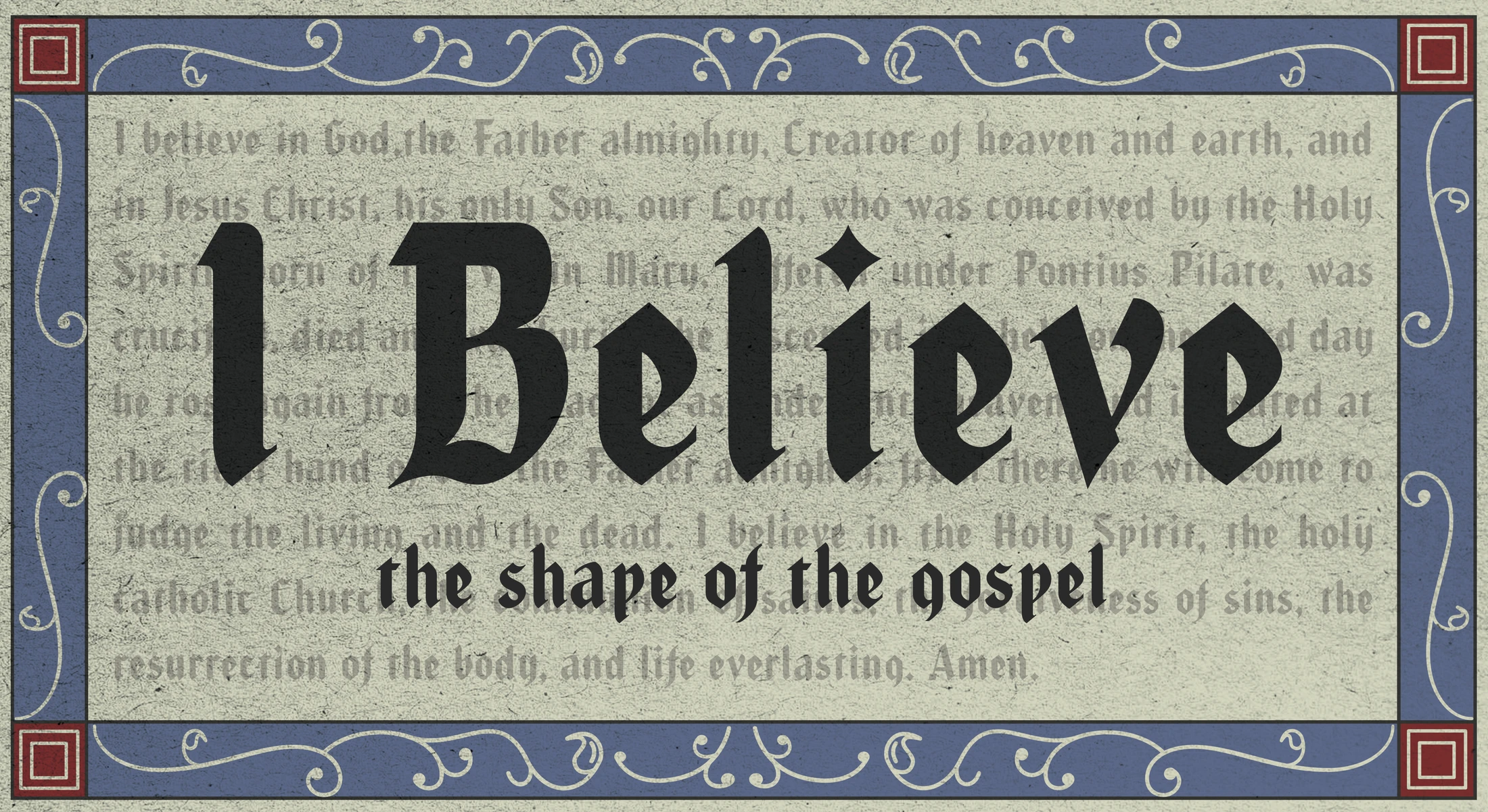
I believe in God, the Father Almighty, creator of heaven and earth, and in Jesus Christ, his only Son, our Lord, who was conceived by the power of the Holy Spirit and born of the Virgin Mary, suffered under Pontius Pilate, was crucified, died and was buried. He descended into hell, and on the third day, he rose again from the dead. He ascended into heaven and is seated at the right hand of God, the Father Almighty. From there he will come to judge the living and the dead. I believe in the Holy Spirit, the Holy Catholic Church, the communion of saints and the forgiveness of sins, the resurrection of the body and life everlasting.
Amen. As you leave today, there are going to be a couple of tables in each lobby, in each atrium, and we have little bookmarks that have the Apostles Creed written down. It written down on them. I want to invite you to take one if you want one. This might be that Lenten practice, that discipline where as you leave something behind, you can pick something else up.
Maybe take the next few weeks as you.