
Shane Hughes 3-29-26

Good morning. My name is Shane Hughes. I'm one of the ministers here. And it is a delight if you were here with us. Whether you're here in town and you wandered into Highland for the first time or you're from somewhere else and you're just here for the weekend, it's good to have you with us.
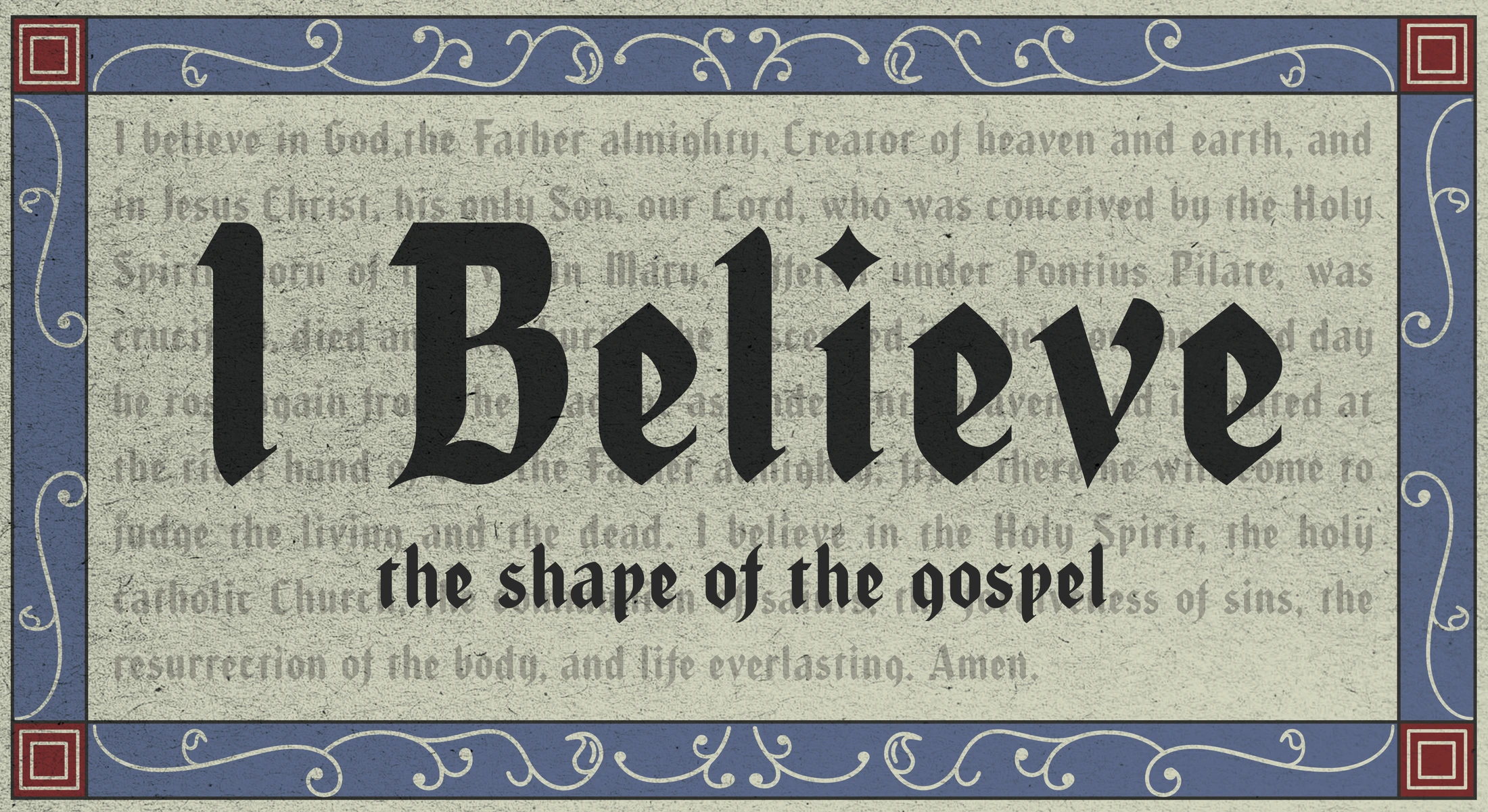
We're in a series on the Apostles Creed, and you may have never heard about this before. The Apostles Creed was an early baptismal confession. It's what early Christians said or said yes to, agreed to before they met Christ in the water. And it became a statement that was near universal in the early few centuries of Christian faith. And today, I want us to begin by thinking about the Book of Hebrews.
Now, the Book of Hebrews is fascinating because it's more of a sermon than it is a letter. And although it addresses some specific issues that are happening in a specific place, it has this rhetorical flourish. And this week, we get to kind of one of the high points of the author's rhetoric, because right. What happens right before our reading in chapter 11 is that the author kind of gives us this image of all the important heroes of faith that have come through the Old Testament, one after another. Abraham and Moses and everyone, one after another, of all these heroic figures that the listeners would know their stories.
But then there's this moment, and it happens in chapter 11, beginning in verse 32, where the author just basically throws up his hands and says, look, I don't have even time to tell you all the stories. People like Gideon and David and Samuel. And then he describes these wild, crazy miracles, almost unbelievable experiences. People who conquered kingdoms, survived the lion's dens, came back from the dead. But then he pivots.
Then they pivot, and they describe others who had just as much faith but got none of the dramatic rescues. They were tortured, they were imprisoned, they were killed. The author calls them people the world was not worthy of.
And I think one of the things that you need to hear from this text is that faith is not a guarantee of comfort or rescue. Some faithful people got miracles, but others got martyrdom. But in Hebrews, both groups are equally honored. And maybe one of the things that you need to hear today is whatever it is you're going through, whatever burden that you're bearing this week, what Hebrews tells us is that someone else before you has walked that road, or maybe even a harder road with the same trust in God.
But what's interesting is then the author goes to say all those heroes of faith did not Receive the fullness of what was promised during their lifetimes. And you might ask her why. And the reason is because the author says that God plans something better, that they wouldn't be made complete or perfect. Finished, mature is the best way to kind of think of that word apart from us. And I think what the author is trying to say there is.
There's. There's something about the kingdom of God, there's something about the church, there's something about the life that it comes from, the indwelling of the Holy Spirit. That is. That is the. The finishing touch.
It is what all of the Old Testament heroes longed for. It's what they wanted to see, but they never got to experience it in their lifetime. Maybe you've heard of the artist, famous painter, Vincent van Van Gogh, or Van Gogh, if you're. If you're Dutch and famous painter. And his.
His work are in the most important museums in. In the world. And his pieces sell for millions of dollars on the rare chance that they do sell. You may not know this, but Van Gogh, in his lifetime, only sold one painting. It was called the Red Vineyard.
Vincent lived in poverty his entire life. He had emotional anguish and profound loneliness. One time, he wrote to his brother Theo, and almost in a desperate belief that his work mattered, that one day it would mean something. And he dies in 1890 at 37 years old. He dies believing he is a failure.
About 10 years later, a decade after his death, the art world began to recognize his genius. And today his paintings are among the most famous and the world. But his letters reveal a man who knew he was reaching for something real. He just never got to see the world reach back. He wrote to his brother Theo that he hoped that his work.
He wanted his work to bring comfort to people the way music does. And now we know millions have found that exact same thing in his painting. He just wasn't alive to know it. He was waiting for a hope, a finish line that he never saw. And so the story of salvation is one big unified narrative.
The Old Testament saints were living in an earlier chapter of a book that finds its completion in Jesus. And we are the generation that gets to see the fullest picture of what they were longing for. It means we carry a baton for a very, very long relay race, and we have more light than they did, with all those faithful witnesses forming a kind of cloud cheering us on. The author tells us to strip off every weight and sin that slows us down and run with endurance. The Greek word here for endurance means active, stubborn persistence.
It's not that runner's high that you feel when you hit mile five. It is the hard mile at 20. It's not just passive waiting, but it's pressing forward under pressure. And when we get to the finish line, what do we see? We see Jesus, the pioneer and perfecter of our faith, the beginner and the finisher.
He ran the hardest race of all. He endured the cross, the deepest shame, and he sat down and victoriously at God's right hand. And so when we feel like giving up, the remedy is simple, although it's not easy. I wanted to say that again. It's simple, but it's not easy.
Look at Jesus. Consider what he went through so you don't go weary and lose heart. Here's the point. The Christian life is a marathon. It's not a sprint.
And the crowd of witnesses is not just an inspirational decor. This is not just something you can pick up at Hobby Lobby and throw up in your kitchen. This is a theological argument. If they held on without seeing Jesus, how much more can we hold on with him as our focal point? And here's the thing about running.
I don't know if you've ever ran before. If you want to start running, you get a couch to 5K and you begin. And in about six weeks, probably you can run three miles. And so you sign up for your 5K and you show up and you go and you run. And inevitably there's going to be somebody there that's faster than you.
That always happens. They've, you know, they did cross country in high school and they can do a 12 minute 5K. You're doing 30 something, it doesn't matter, right? And there's somebody else at that race that's going to say, hey, look, man, 5Ks are great, but if you really want to experience a good race, you need to run a 10K. And so you'll begin training.
And 10K is a lot harder than a 5K. It's twice as far. And so, yeah, you get there and then you show up for your 10k race again. Some motor shoots by, you finish and somebody says, man, you said so. Well, at that 10K, you know what you should think about?
You should think about a half marathon. And you're like, I did 10k, I could probably do a half marathon. It's not the same thing. But you train and you try. And when you get to that half marathon, do you know what somebody's going to say?
Try a marathon. Now that's crazy talk. Don't do it. But if you did, and you got to the marathon and you finished. You feel the most accomplished maybe than you felt physically in your life.
And somebody is there, says, yeah, a marathon is great, but have you done an ultra? A friend of mine, he and I worked together at a church in California. He ran ultramarathons, 100 kilometer race. And after he did the 100 kilometer race, he did 100 mile race. You start in the middle of the night and you just run the whole time.
He did two of these in the state of California. And when he got to the end of a hundred mile race, do you know what somebody said to him? You know, this ultra is great, but if you really want to do an ultra, you should run in leadville, Colorado, right? 14,000ft. It's crazy, right?
The point is simple. You're always going to meet someone who runs further or has a more challenging race or can run faster. But it doesn't matter the speed or the distance. It doesn't matter if you're running in the Boston or at Red Bud. If you're running, run well, run well.
So there's a line in the Creed that I mentioned a couple of times in the first few weeks, and sometimes it's a sticking point for us. I believe in the Catholic Church. I know. I know for some of you, the word Catholic lands like a stone in the water and you flinch a little, maybe even go quiet when we get to that part of the Creed. And I get it, some of you have had experiences with different experiences than the ones with mine.
But this is what I want you to sit with this morning. That word, before it ever belonged to Rome, it was before it was ever printed on any church marquee or etched above a cathedral door. It simply meant universal. It meant whole. It meant, And I want you to feel the weight of this.
It meant everyone, all of us. And that's what I love about that word Catholic. Universal. It means the Church with the capital C was never supposed to be a club. It was never supposed to be a place where people that look like me and think like me and act like me get together and agree with one another and then feel very comfortable.
The Creed is making this kind of wild, borderless, almost offensive claim that the body of Christ is everyone who has ever said yes to Jesus. Every century, every continent, every language, every person sitting in a pew who is barely holding on to it today. Which is, if we're going to be honest, a lot of us. But then you put the word holy before the word Catholic. And when you say holy, Catholic Church, you're going to make one of the most audacious claims a human being can make.
You are saying that God has been building something, that he's been building it for a long time and that it is God's set apart. It's called out, and yes, it's redeemed across every century, every continent and every language and every group on this earth.
And early Christians, when they were confessing this at their baptism, weren't drawing a circle around their particular congregation or on their particular street or in their particular city. They're making an enormous, it's almost a reckless claim that God is what God is doing in Jesus is not regional project. It's not a cultural preference. It's not a movement of people who already have their lives together. It is.
And it was as wide as the whole world itself.
And sometimes I think about this when we take communion, especially when I take communion beside someone that I don't understand.
I don't understand how they possibly could have voted the way they did. Someone whose choices are baffling because I am so ignorant of their life experience. The decisions they made don't make sense to me. Or someone whose grief is so different than mine I can barely find the words to connect with them. And still, even so, we reach out our hands for the same bread.
And whether we like it or not, we are one body.
The church is not a gathering of the like minded. It's the gathering of the called. And the call, it turns out, went out to absolutely everybody.
And then we go back through time for just a second because this thing didn't start with us, friends. It's not even close. There were men and women sitting in catacombs under Rome, whispering the same gospel that we can preach aloud in this room. And they were holding onto it with everything they had. There were Celtic monks on the edge of the world, copying scripture by hand, time and time again so that the Word would not be lost.
But there were African theologians in the third and fourth centuries hammering out all of the doctrines in which we stand in faith on today. People like Tertullian and Athanasius and Augustine. And the Church did not cave, it did not fall, and it did not disappear. But it was pressed and it was persecuted and it was scattered and it kept going.
Because here is what the Holy Catholic Church is. It's a community of the redeemed. It's the people that Jesus purchased with his own blood. And he has been faithful to keep it what it is. And then revelation gives us this picture of it at the end, it's every tribe, every tongue, every nation gathered before the throne.
And that's not some sort of future fantasy. That is the destination of the thing that we are already a part of. The church isn't headed toward failure. It's headed toward fullness.
And I don't know about you, but in my life I've had a few pretty hard years. And in those hard years, in that hard time, I found out that the church. And this strange kind of universal, broken. It's a beautiful thing. Showed up in ways that I never expected in my first century of seminary.
Or first felt like a century. First year of seminary when. When I didn't know how to pray. This. This Kentuckian farmer, theologian, poetry, there.
His poetry kept me sane. It showed up to this Jesuit preach priest who taught me how to pray. It showed up at this black Baptist congregation here in Abilene. Singing a hymn that I had never heard before. But somehow it was exactly what I needed.
And I think that's the communion of the saints. It's not a doctrine designed to make you feel better. In a vague, unique, kind of greeting card sort of way. But it is a very specific claim that Perpetua, who died for her faith in 203 AD. And your grandmother, or at least my grandmother, who taught me how to pray, to fold my hands and to bow my heads.
And they are tied to that single mom who's three rows back from you right now. Who showed up today even though she didn't really want to. That you are all somehow one thing. Together we are a holy Catholic church. And there's this practice that the early Christians and the oldest Christian traditions have of praying with the dead.
And I understand that for some of us, that's going to make us feel a little uncomfortable. I get it. Right? We grew up in a rational world with a very modern mindset. And we all kind of think it.
We can reason it together out, brothers and sisters. And so this is going to make you feel a little uncomfortable. But what I want you to do is I want you to step out of your mind. Because sometimes we pray with, like, our cerebral frontal, cerebral cortex, right? Please help the doctors to have great sleep and to be accurate in their ability.
And sometimes I pray with, like, the back of my brain, my brain stem. Help me. And sometimes we approach God from the front. And sometimes we approach God from the back of our brains. And I want you to approach God through the lens of mystery.
Right now. Stay with me, because it sounds, at first blush, like I'm going to talk about a Ouija board and candles, but that's not really what I'm saying. The creed says, I believe in the communion of saints. Same word for communion that we celebrate today. It's the same word for the table.
It's a sharing word. It's a participation word. It means what binds us together is not proximity. It's not even memory. It's something even more stubborn than either of those things.
It's the life of God moving through God's people like a current through water. And that current, the church has always insisted, does not stop at death.
And this is what I mean. You've had that experience where you've had a tough spot in your life and you've needed someone to pray for you. And you go to someone that you know and say you trust, and you say, hey, would you pray for me? Or you go, when I have a concern, I can go to my elders and I can say, I need advice and I need you to pray for me. And I trust these people to take care of me spiritually, to pastor me well, because I know them and I trust them.
But don't I know and trust those who are already dead? Right. We believe in the power of prayer, and we believe in the resurrection. And this is the place where those two circles touch one another.
I've been thinking about my grandmother this week. She taught me to pray, hands folded, head bowed. And she's been gone for 30 years now.
And my dad's been gone a little bit longer.
He had a tough, tough go the last 10 years of his life. He had a heart attack and then kidney failure. He was on dialysis. And he suffered a lot toward the end of his life. And there were times toward the end when he was suffering, when it was hard, that I wished.
I never was able to tell this to anyone, but I kind of wished that his suffering would end. And even if that meant his death, it would be okay. I got to tell you the truth right now. I would pay a lot of money just for one hour of a conversation with my dad. But he did pass.
He did pass. And then eight days later, after his funeral, I had this dream. I think first service today was the first time I've told this story in public that might be wrong about that. But I had this dream, and my father was there.
And he wasn't the father that I knew. He wasn't tired and he wasn't sick. His back wasn't bent over. He was younger than I ever knew him.
And he looked at me and he smiled at me, and he said, let's run. My dad hadn't ran for the last 20 years of his life. And he turned and he ran, and he was gone.
The communion of the saints is that edge of mystery where our belief in the effectiveness of prayer and our belief in the resurrection come close to one another, because those who are dead aren't really gone.
And on those days when your faith feels as thin as paper, you get to borrow from the communion. You can show up on a church on a Sunday, and you could say, I want to believe, but I'm really wrestling with belief. I want to believe God, you are good. But my life, I don't feel it in a very real way right now. I want to believe that you have love for me, but I've done some pretty terrible things this week.
And I'm having a hard time believing that you're gonna show up on a Sunday and your faith is gonna feel really thin. And on those days when you show up and your faith feels like that, trust the communion, you get to say, I can't hold this today, but we are gonna hold it together. And that's not weakness. That's exactly what the church was designed for. Now, is the church perfect?
No. You know it isn't. I know it isn't. History knows it isn't. And there are.
There have been chapters that have been written in the church's story that are genuinely painful to read. And we don't have to pretend otherwise. But here's what I keep coming back to. Jesus said, I will build my church, and the gates of hell will not prevail against it. He didn't say might not prevail against it.
He didn't say, probably won't prevail against it. He said, God will not. And for the last 2000 years of history, messy and glorious and painful and beautiful as it has been, has proven him right. The church is still here, and the gospel is still going, and people are still being redeemed. And I don't have time.
I don't have time to tell you about the cloud of witnesses that surrounds this room, that surrounds our table. This week, we were hosted by the Maxwells. And last week it was Erica and Dean, and the week before that, it was Jason Fikes. And the week before that and the week before that. And you could go back nearly 100 years of people presiding over our table, of people standing in our cloud of witnesses.
I don't have time to tell you about Joe Bass. Joe Bass taught this church about the Holy Spirit. Before jobass came to this church, it was like we were a perfectly functional black and white TV with perfect audio. And then she introduced us to color. I don't have time to tell you about Maria White.
Maria showed up and began a ministry to an apartment building where she loved on children. And from that moment, from her desire to love those kids was born freedom and was born grace. I don't have time to tell you about Grady and Nell Jolly or Audrey and Bill Nash who taught us how to love the least of these. I don't have time to tell you about Clovis Fowler and Glenn Owen who had the vision to see what no one else could see and then set their eyes and go for it. I don't have time to tell you about John and Evelyn Willis who taught us that brilliant and humble hospitality can live in the same person.
I don't have time to tell you about Wally Bullington or Lynn Anderson or Landon Saunders, but I do have time to tell you that they are our cloud of witnesses, that they stand in the bleachers of heaven and they are cheering us on. And here's the hard thing about what I just said is that my guess is about half of us don't know any of the names I just read. I bet about 75% of us don't know those stories. I also know it's true that I didn't tell a bunch of stories that are near to your heart. I don't have time to tell you about the nursery worker that served for 30 years and then retired from the nursery and nobody knows her name.
I don't have time to tell you about all of the faithful givers that showed up week and week out despite illness or doubt. I don't even know all those names, but I think you do.
I think you know the name of the spiritual grandma that taught you to pray. I think you know the name of your sponsor that taught you sobriety. I think you know the name of the best friend from high school who invited you to church and changed your life.
Can you hear them?
They are standing in the bleachers of heaven and they are cheering you on and they've handed us the baton and now it's our turn to run. Watching us run the race, God has set out for us.
And so Highland, it doesn't matter how far you go, it doesn't matter how fast, it really doesn't matter how challenging your course. All we have to do is run well at the end of our services. We've been saying together this confession, this baptismal confession, the Apostles Creed. I want to invite you to stand and say that with us today.